
Table of Contents
To understand what a SOC 3 report is, it helps to start with what SOC stands for: System and Organization Controls. If your organization handles sensitive data such as client records, financial information, or personal details, you’re under pressure to prove you protect it. Devices such as servers, computers and hard drives, if mishandled, can trigger a breach, a fine, or a damaged reputation. This article answers the question: What is a SOC 3 Report?
If you’re wondering what a SOC 3 report is, it’s a report that services as one of the clearest ways for a company to publicly demonstrate trust and security assurance. In this guide, we’ll explain what a SOC 3 report is, how it compares to SOC 1 and SOC 2, and why obtaining one can strengthen your company’s credibility, support compliance, and shorten sales and vendor-approval cycles.
What Is a SOC 3 Report?

A SOC 3 report is a public-facing summary of your organization’s controls related to security, availability, processing integrity, confidentiality, and privacy. It’s produced by an independent CPA firm following the AICPA’s SOC (System and Organization Controls) framework.
Unlike internal compliance claims, a SOC 3 report confirms that a third party has examined your controls and verified they work as intended.
Here’s what makes a SOC 3 report distinct:
- Public distribution: It’s designed to be shared freely, often posted on your website or handed out during procurement.
- General-use audience: It contains no sensitive control details, so any prospective customer or partner can review it.
- Independent attestation: A licensed auditor confirms your organization meets the relevant Trust Services Criteria.
- High-level summary: It validates that your controls exist and function, without exposing technical specifics that competitors could exploit.
For a company that wants to build trust quickly, that last point is key. You get to demonstrate a strong security posture without handing prospects pages of confidential control descriptions.
SOC 1 vs. SOC 2 vs. SOC 3: What’s the Difference?

The SOC framework includes three report types, and they serve different purposes. To understand what is a SOC 3 report, it helps to see how SOC 3 compares with SOC 1 and SOC 2. Knowing the difference helps you decide which report your organization actually needs.
SOC 1
SOC 1 focuses on controls relevant to financial reporting. It’s the right choice when your services could affect a client’s financial statements, such as payroll or transaction processing. If your goal is to demonstrate data security rather than financial controls, SOC 1 is rarely the right benchmark.
SOC 2
SOC 2 evaluates your controls against the Trust Services Criteria: security, availability, processing integrity, confidentiality, and privacy. It’s detailed and restricted in distribution, often requiring a non-disclosure agreement before you share it. SOC 2 is the gold standard for showing exactly how you protect data.
SOC 3
SOC 3 covers the same Trust Services Criteria as SOC 2 but in a condensed, public format. It confirms the audit happened and passed, without revealing the granular control details found in a SOC 2 report.
Here’s the simplest way to think about it:
- SOC 1 = financial controls
- SOC 2 = detailed security controls (restricted access)
- SOC 3 = public summary of those security controls
Many organizations pursue both SOC 2 and SOC 3. The SOC 3 is what you can publish openly and share with anyone, while the SOC 2 is what you provide under NDA when a customer or auditor needs a deeper look.
A SOC 3 Report Example: What It Looks Like
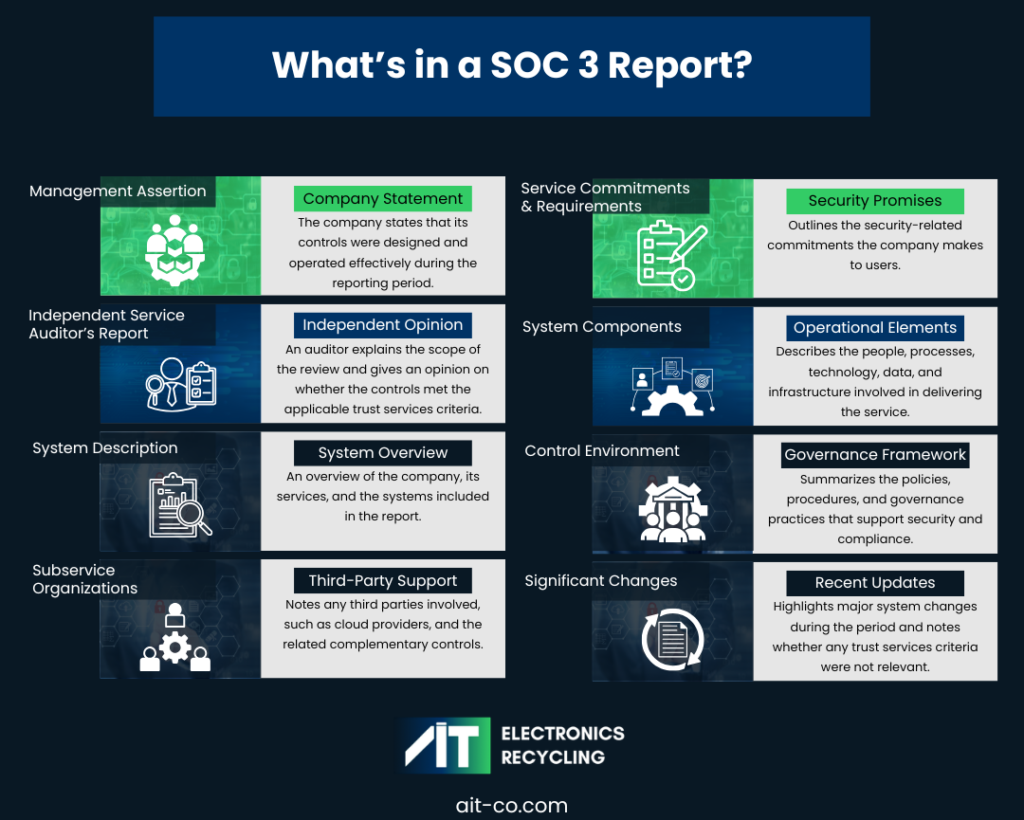
If you’re still wondering what is a SOC 3 report, it helps to have a top-down view of the key sections that they include. A strong report would typically include:
- An independent auditor’s opinion. A statement from a CPA firm confirming your controls met the Trust Services Criteria over a defined period.
- System description. A summary of the services covered, such as data storage, access management, and physical security.
- Trust Services Criteria addressed. Confirmation that security and confidentiality controls were tested – often the two most relevant to data-handling operations.
- The reporting period. SOC reports cover a window of time (often 6 to 12 months), so the period should be current and clearly stated.
In this SOC 3 report example, the value is clear: Anyone reviewing it sees, in plain terms, that an outside auditor verified your ability to protect data, replacing dozens of back-and-forth security questions during service procurement.
If a prospect is comparing your company to a competitor and only you can show a current SOC 3 report, the choice gets a lot simpler in your favor.
Why SOC 3 Reporting Matters for Your Company

Every system you operate is a potential point of failure that customers and regulators care about. If you’re asking what is a SOC 3 report really means to accomplish, it comes down to reducing doubt around your controls.
It validates real, tested controls
Anyone can claim they “take security seriously.” A SOC 3 report proves an independent auditor examined those claims and found them sound. That’s the difference between marketing language and verified performance.
It supports your compliance obligations
If your organization must meet standards like HIPAA, GDPR, PCI DSS, or any state or local data privacy laws, a SOC 3 report helps demonstrate due diligence to auditors, regulators, and partners. It also reassures clients who must account for the security of every company in their own compliance chain.
It accelerates sales and vendor approval
Prospects increasingly require proof of controls before signing. A public SOC 3 report lets you answer that requirement instantly, without waiting on NDAs or lengthy questionnaires, shortening your sales cycle.
It protects against breach liability
A single security failure can lead to notification costs, regulatory penalties, and reputational harm. Operating to audited standards, and proving it with a SOC 3 report, reduces that exposure and signals a mature security program.
Common mistake to avoid: Don’t treat the SOC 3 report as a one-time checkbox. A single audit confirms a snapshot in time; maintaining the underlying controls is what keeps your attestation credible year after year.
Putting It Into Practice
By this point, the answer to “what is a SOC 3?” report should be clear: it’s a public, third-party-validated way to show your company can protect sensitive data. For organizations running offices and data centers, having that answer ready builds trust before a prospect even asks.
To put this to work:
- Decide which report you need—SOC 2 for detailed review, SOC 3 for public proof, often both.
- Prepare your facility and systems so controls are documented and operating as intended.
- Engage an independent CPA firm to perform the audit against the relevant Trust Services Criteria.
- Publish and share your SOC 3 report, and keep the reporting period current.
Make SOC 3 reporting part of your security and compliance strategy. It’s a clear, audited way to demonstrate that your organization protects the data entrusted to it – and to give customers, partners, and regulators confidence in your operations.