
Table of Contents
Most data center challenges come from the equipment that’s being moved, retired, or replaced. A live server sitting in a monitored, badge-access facility is well protected, but the same server loaded onto a truck, sitting in a staging room, or waiting in a holding facility is far more exposed.
These transitional moments, including refreshes, consolidations, cloud migrations, and facility closures, are where data security, compliance, and operational continuity all come under pressure at once. Understanding the four challenges below helps you plan for them before they become incidents.
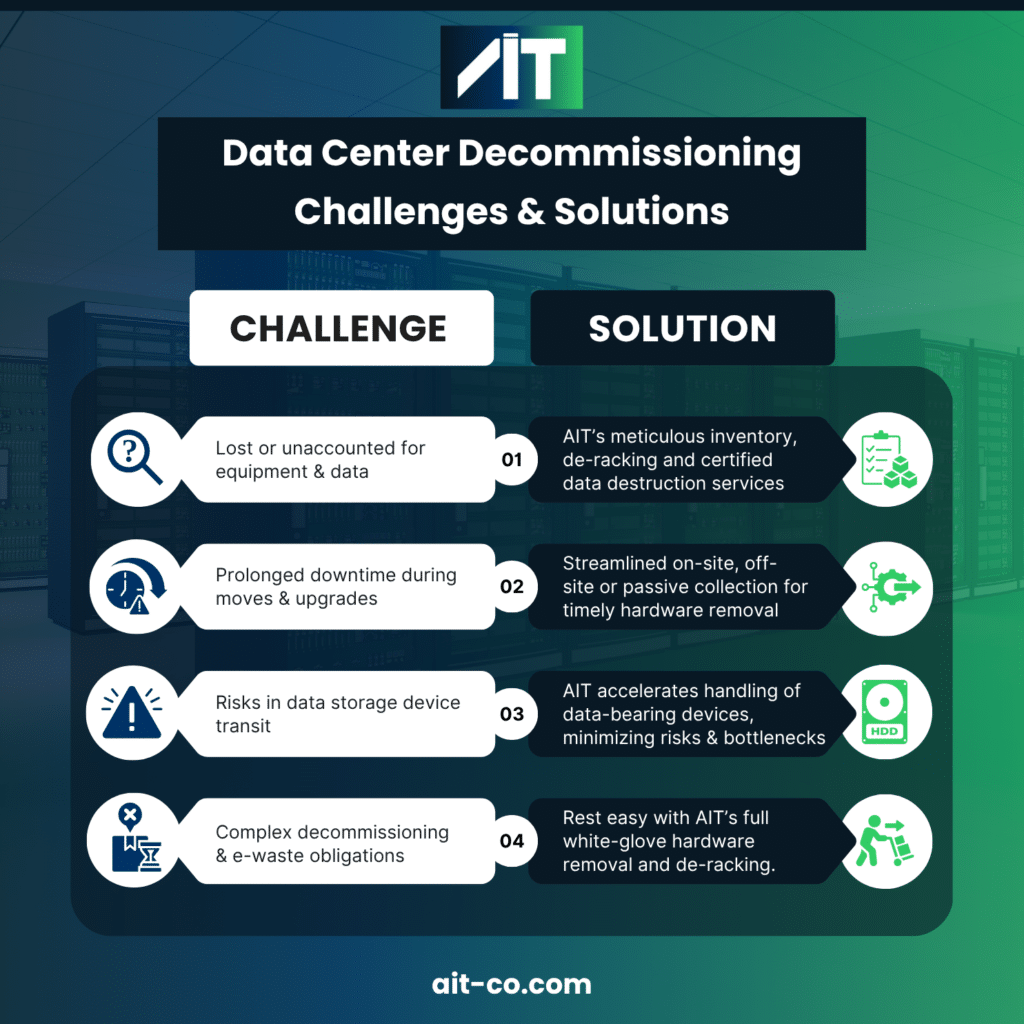
Center Challenge 1: Lost or Unaccounted Equipment and Data

A single data center can hold thousands of data-bearing devices: hard drives, SSDs, RAID arrays, backup tapes, and storage networks. During a refresh or decommission, those assets move quickly and in large volume. Without a disciplined tracking system, devices get miscounted, misplaced, or overlooked entirely. An undetected drive left in a server chassis, a tape pulled from a backup unit, or a pallet logged by weight instead of serial number all create gaps in your inventory record.
Why It Matters
Every unaccounted device is a potential data exposure event. If your compliance team can’t prove a drive was destroyed, you have to assume it wasn’t – and that assumption carries real consequences:
- Audit failures: HIPAA, GDPR, PCI DSS, and SOC 3 auditors expect documented proof of disposition for every data-bearing asset.
- Regulatory exposure: Under modern privacy law, liability follows the data owner. A missing drive is your liability, regardless of who handled it last.
- Breach risk: A single overlooked drive can surface on a secondary market or in a landfill with recoverable data still intact.
How to Address It

The fix is serialized accountability from the first touchpoint to final disposition. Strong ITAD programs apply these practices:
- Individual serial number scanning: Every device is logged and reconciled against a master asset list instead of simply counted by bulk or weight.
- Methodical de-racking: Trained teams pull all data storage media from devices, including embedded or hot-swap media that’s easy to miss.
- Certified destruction tied to each serial: A Certificate of Destruction references the specific serial number of every drive erased or shredded. for full chain-of-custody documentation.
- Reconciliation reporting: A closeout report confirms that the number of assets collected matches the number processed and destroyed.
Key takeaway: If you can’t tie a destruction record to a serial number, you haven’t closed the loop on that asset. Serialized tracking turns “we think it’s gone” into “here’s the proof.”
E-waste recycling providers with robust ITAD program solutions build this accountability into their workflow, scanning each device and issuing serialized documentation so nothing leaves the record unaccounted for.
Challenge 2: Prolonged Downtime During Moves and Upgrades

Data center moves and hardware upgrades require physically removing, relocating, or replacing live infrastructure. Done poorly, this work drags on: hardware comes out in the wrong order, dependencies aren’t mapped, and systems stay offline longer than planned. For a facility built around a 99.99% uptime target, every unplanned hour of downtime erodes the entire margin.
Why It Matters
Downtime isn’t just an inconvenience; it’s a measurable operational and financial cost:
- Lost revenue for every hour critical systems are unavailable.
- SLA penalties when availability commitments to internal or external customers slip.
- Cascading pressure on operations teams forced to recover time on an already tight schedule.
- Increased error risk when rushed work leads to mishandled hardware or skipped documentation.
How to Address It
Minimizing downtime is a matter of planning and execution discipline. The most reliable approach combines flexible collection models with documented, repeatable processes:
- On-site collection and data destruction for projects that need hardware removed and processed without leaving your control prematurely.
- Off-site processing when you need equipment cleared quickly and handled at a secure facility.
- Full white glove materials prep so that your team doesn’t have to pack, wrap and palletize equipment.
- Passive or scheduled collection for phased refreshes that you want to manage gradually around live operations.
- Sequenced de-racking and removal that respects system dependencies so you decommission in a logical, low-risk order.
- Documentation at every step, so each removed asset is wiped or destroyed and recorded as the work happens, not after.
Operational note: The goal isn’t just speed; it’s predictability. A repeatable removal workflow lets your team forecast downtime windows accurately and keep the rest of the facility running.
A structured ITAD partner coordinates removal, data handling, and documentation in one motion, which keeps disruption contained and your uptime intact.
Challenge 3: Risks in Data Storage Device Transit

The most vulnerable point in any decommissioning project is transit. Once a drive or storage array leaves your facility, it passes out of your direct control. If it’s handled like ordinary freight, you have no visibility into where it is, who has access to it, or how it’s being stored along the way.
Why It Matters
Standard logistics carriers don’t treat data-bearing devices any differently than furniture or packing materials. That creates a serious gap:
- Common carrier liability: This typically covers loss by weight, not by the value of the data on the device. If a pallet of drives disappears, you’re reimbursed for the plastic and metal, and left holding the cost of the breach.
- Broken chain of custody: Gaps in transit are exactly where auditors focus, because that’s where data goes unaccounted for.
- Extended exposure windows: Hardware sitting unsecured in a holding facility for days or weeks multiplies the risk of loss or tampering.
How to Address It
Secure transit comes down to maintaining strict chain-of-custody control from pickup to processing. Best-in-class handling includes:
- Locked, secure bins loaded on-site so devices are contained from the moment they’re pulled.
- Dedicated, GPS-tracked vehicles rather than shared freight, with geofenced routes.
- Automated route alerts triggered if a driver makes an unscheduled stop or deviates from the planned path.
- Serialized intake at a secure facility so every device is reconciled against your master list the moment it arrives.
Fast fact: Geofenced transport means an unauthorized detour between your facility and the processing site sets off an immediate alert, closing the visibility gap that ordinary freight leaves wide open.
By treating data-bearing devices as high-value, controlled assets in transit, an A-1 ITAD solutions providers like AIT reduces reliance on slow or unverified external processes and keeps the chain of custody custody intact end to end.
Challenge 4: Complex Decommissioning and E-Waste Sorting Obligations

Large-scale data center decommissioning involves de-racking, sorting data-bearing media from non-data assets, routing devices to the correct destruction or recycling path, and documenting all of it for compliance. The volume and variety, including servers, switches, PDUs, UPS systems, cabling, telecom gear, and batteries, can overwhelm regional logistics teams who don’t specialize in this work every day.
Why It Matters
Decommissioning sits at the intersection of two regulatory worlds, and both carry liability:
- Data compliance: Every storage device must be sanitized to a recognized standard and documented.
- Environmental compliance: Electronics contain hazardous materials. Improper disposal can lead to soil and groundwater contamination, fire risk from mishandled batteries, and significant environmental liability.
- Resource waste: Treating viable hardware as scrap discards recoverable value and recyclable materials that could re-enter the supply chain.
How to Address It

The answer is a full-lifecycle process that handles removal, destruction, recycling, and documentation under one accountable workflow. Look for these elements:
- Complete hardware removal and de-racking handled by experienced teams, so no asset is left behind.
- Recognized destruction standards such as NIST SP 800-88 Rev. 2, DoD 5220.22-M, and IEEE 2883-2022 for data-bearing media.
- Certified, responsible recycling under R2v3 and e-Stewards standards for non-viable e-waste.
- Value recovery where possible: Functional servers, networking gear, GPUs, and workstations can be tested, refurbished, and remarketed, offsetting project costs rather than adding to them.
- Audit-ready documentation, including a Certificate of Destruction, a Certificate of Recycling, and a full chain of custody e-waste report.
The bigger picture: Done right, decommissioning becomes a cost-recovery opportunity. Revenue from remarketing viable assets can offset the cost of securely destroying and recycling the rest, turning an end-of-life expense into a balanced line item.
AIT’s model brings removal, destruction, recycling, and reporting together, which simplifies most data center challenges during a move or recycling project and keeps both data and environmental compliance intact.
Putting It Into Practice

The four challenges above share a common thread: they all surface during transitions, and they’re all solvable with the right process discipline. You don’t manage them by reacting after a project ends; you manage them by building concrete accountability in from the start.
To put this into practice across your next refresh, migration, or decommission:
- Inventory before you move: Identify every asset that you would like to recycle or move, including servers, drives, arrays, tapes, and any embedded media, before work begins.
- Insist on serialized tracking: Require individual serial number scanning and reconciliation, not bulk or weight-based counts.
- Control the transit layer: Use secure bins, GPS-tracked vehicles, and chain-of-custody documentation for anything carrying data.
- Apply recognized destruction standards: Hold every device to NIST SP 800-88 Rev. 2 or stricter, matched to the media type.
- Recover value where it exists: Evaluate viable hardware for remarketing before defaulting to recycling, to ensure a potential return on budget.
- Close the loop with documentation: Keep your Certificates of Destruction, Certificates of Recycling, and e-waste reports current and audit-ready.
Handled this way, the moments that introduce the most risk into your environment, including moves, upgrades, and end-of-life retirements, become controlled, repeatable, and fully documented. That’s the difference between hoping a retired drive was handled correctly and knowing it was, with the proof to back it up.
Ready to Turn Risk Into Confidence?
Don’t risk your company’s data, uptime, or compliance by leaving data center disposition to anyone but the experts. Click here to partner with the leaders in secure, certified, and sustainable IT asset decom and data destruction for data centers nationwide today.